
‘Make your daddy dead. Real dead.’ – God
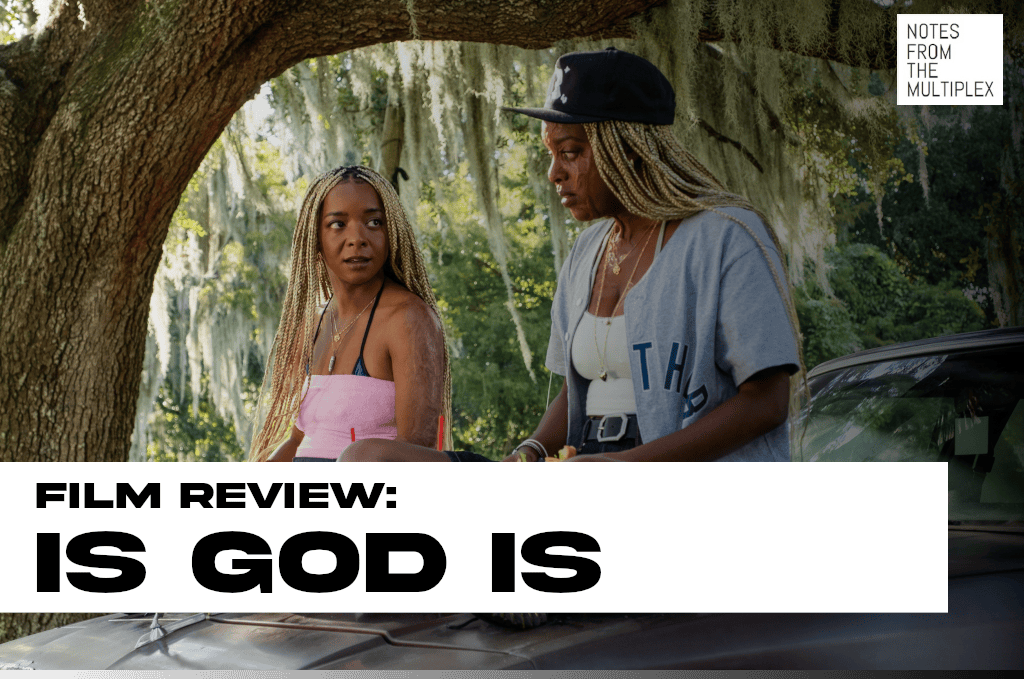
Adapting her own stage play of the same name, Aleshea Harris’s Is God Is is a fiery revenge drama fuelled by righteous female rage. In its opening sepia-tinged shot, Harris introduces us to two young twins, Racine and Anaia. Shot from behind as they sit on a park bench, the pair initially appear to be normal children enjoying the scenery, but the twins are revealed to bear the upsetting scars of a horrific attack suffered alongside their mother at the hands of their sadistic father. Whilst other revenge narratives of this type often see the protagonists haunted by the mostly unseen psychological damage of the injustices they have suffered, Racine and Anaia’s lives are defined by the inescapable physical reminders of their past. The physical manifestations of this trauma are most prominent for Anaia (Mallori Johnson), her face and chest bearing the worst of her scarring, whilst Racine’s (Kara Young) injuries are confined mostly to her arm. Nonetheless, we learn that the sisters have been ostracised by society for their appearance, unable to find steady or sympathetic employment or maintain romantic relationships. Instead, they have each other, living a mostly quiet existence in each other’s company, until a letter from their presumed-dead mother (Vivica A. Fox), a woman whom they refer to as ‘God’ (she made them), asks them to confront to the primal scene of their trauma: to hunt down and kill the man responsible for their pain, their father (a menacing Sterling K. Brown).
For a directorial debut, Harris’s filmmaking is already confident, predicated upon evocative visual storytelling and stylistic flair. Is God Is, although dealing with a very real type of crime (domestic abuse and violence), places its characters in a slightly exaggerated reality: split-screen compositions frequently bring the twins together as mirror images; the fourth wall is broken in extended monologues that outline the tragic history of this family; imagined sequences and hazy memories are intertwined with the film’s present. Elements such as these suggest the text’s genesis in theatre, although Harris is careful to exploit the specific opportunities offered by film as well. Racine and Anaia, two characters whose shared lived experience extends from their mother’s womb to the present day, are so simpatico that they are able to maintain conversation through facial expression and gesture alone. Their unheard dialogue, humorously captured through on-screen text, emphasises the power of their shared connection.
One way to position Is God Is would be as part of a lineage of female-centred revenge dramas including Lady Snowblood, The Bride Wore Black or Kill Bill. Indeed, there are clear echoes of Tarantino’s work at play here, with his film’s postmodern cine-literacy and playful score offering clear points of reference for Harris. But whereas Tarantino opts (as he is one to do) for style over substance, Harris’s narrative explicitly draws attention to the institutions and societal conventions that allow a man like Brown’s character to commit such crimes and walk away from them. As the sisters journey across the country, following their father’s trail through subsequent romantic partners, lawyers and second families, Harris works to critique the damage of patriarchal privilege propped up by church, state and ‘family values’. Brown’s character has been allowed to ‘move on’, his actions dismissed by himself and others as the mistakes of an adolescent who knew no better. He is shielded by the promise of redemption offered by his new-found religion and the safety net provided by an apparently picture-perfect new family life that society would argue is too promising to unravel. So manipulative is the father that, in the film’s final act, Harris has us doubting his guilt, highlighting the danger of this brand of male entitlement.
In its final act, the limitations of its comparatively modest budget ($14.8 million) perhaps begin to show, with its climactic showdown falling short of the kind of denouement this kind of narrative demands. But it is a testament to the filmmaker’s ideological purpose and visual creativity that this only becomes apparent at this point, with the weak link in the chain being some slightly underbaked VFX work and clumsy choreography rather than a failure of its sociopolitical message.