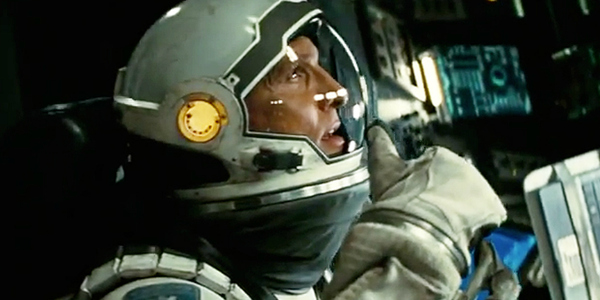
It’s difficult to defend a film when there is a fundamental truth within the majority of criticism lobbied against it. The simple fact is, Interstellar, Christopher Nolan’s latest sci-fi epic, does have plotting issues. At times the film boils down to nothing but straight exposition and at other points is lacking in discipline when it comes to rhythm and pace. But for all its flaws, this reviewer could not help but admire Interstellar for all its scale, ambition and cinematic bravado, even if the end result is not the sci-fi masterpiece many believed it could have been.
In some not too distant, near-apocalyptic future, Earth is slowly running out of resources and ravaged by dust storms and disease which ruin food supplies and torment the dwindling population. As a largely agrarian dystopia, farmers now have the most important roles to play within society, and after his unexpectedly interrupted initial career as a NASA test pilot, this is exactly the job that Cooper (Matthew McConaughey) falls back on to provide for his family of two young children Murph and Tom, and his father-in-law Donald (John Lithgow). Whilst the family lives a quiet life farming corn, Murph, Cooper’s precocious 10 year old daughter, begins to believe that something or someone is trying to communicate with her in her room, where she experiences a series of gravitational anomalies and strange occurrences that leads to her referring to the presence as her ‘ghost’. After a large dust storm sweeps into the house, only for the dust itself to fall, as if communicated by some invisible force, into an unnatural pattern which appears to reveal in binary the geographical location of a NORAD facility housing the last remnants of the NASA programme, Cooper finds himself involved in humanity’s last bid for survival by trying finding a suitable planet for the human race to colonise.
At NASA, Cooper is inducted by his former professor, Prof. Brand (Michael Caine), who explains that a wormhole has been detected near Saturn and that several space crews referred to as the Lazarus mission, have travelled through the wormhole to another galaxy in the hope of discovering a new home for humanity. Although the messages sent back to Earth are ambiguous and infrequent, there is a belief that a suitable home may have been found, prompting a new expedition to confirm and establish a colony far away from the problems of Earth.
Cooper, having made the decision to leave all that he loves and holds dear behind, in the hope that he may secure their future, but equally aware that he may never see his children again, becomes a part of the crew of the Endurance: a four-person team which also includes Brand’s daughter Amelia (Anne Hathaway), Romilly (David Gyasi) and Doyle (Wes Bentley). This concludes the first act of the film and begins an exploration of the depths of the universe, human nature and the very survival of the human race.
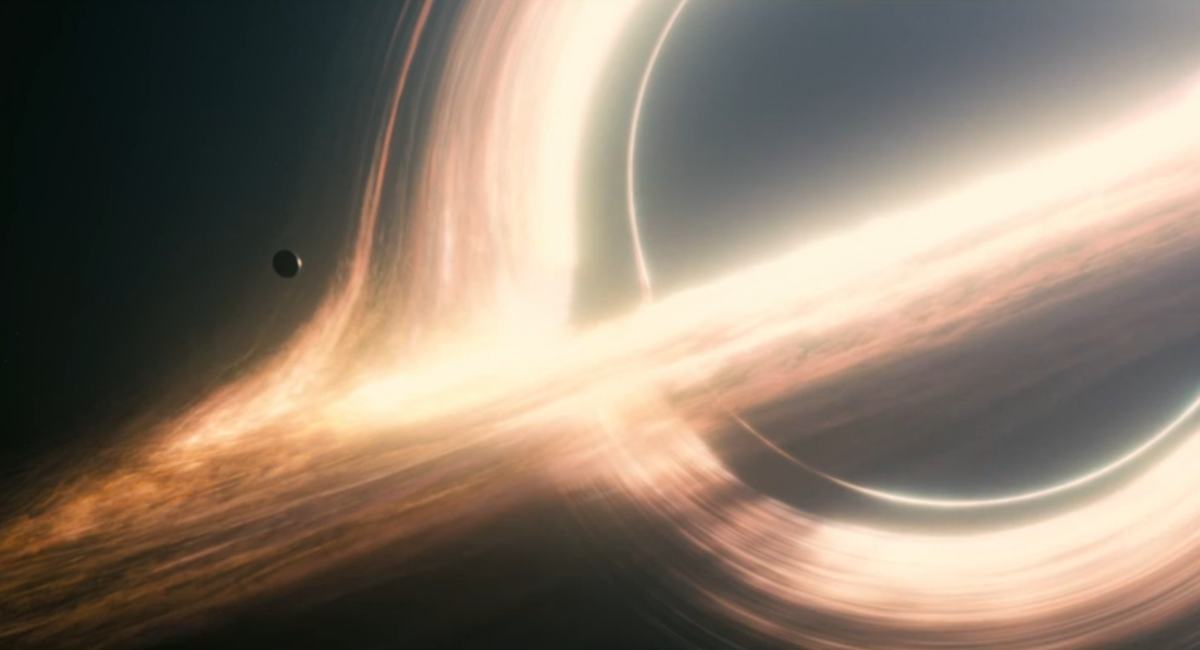
The aforementioned issues of plotting begin quite quickly within the film’s duration, but are most notable upon arrival at NASA where Michael Caine’s character gives a guided tour of the facility, the Endurance crew’s mission, and the basic ideas of the science at hand. It’s a strange interlude, breaking the pace of the film in a manner far more than one would want. Compared to the similar moments of exposition in Nolan’s earlier sci-fi venture Inception, where reasonably complex ideas and plot-points relating to the logic of dream space/time are nestled neatly within montage sequences which maintained the film’s rhythm and propelled it forward: such moments of exposition in Interstellar aren’t handled with the same kind of precision, and feel more like momentary departures from the narrative rather than a part of the film’s driving force.
Whilst it’s easy to see where Nolan is taking his audience by the hand, these moments aren’t as obscene as some have labelled them as being. Yes, this early Caine monologue at NASA is a little on the nose, but a necessary introduction to the mission for the audience and by far the most pronounced sequence of exposition in the film, save for one smaller section in which the mechanics of a wormhole are explained. Given the scale of Nolan’s film, one has to expect a bit of leeway with exposition when it comes to its scientific aspects or risk losing the audience altogether, and at its core it’s a film which places the audience first, achieving a near-perfect balance between blockbuster visuals and action, thought provoking thematic ideas and emotionally resonating drama.
It’s a narrative which aims far above the B-movie simplicity of the recent Gravity, towards the heights of Kubrick’s 1968 masterpiece 2001: A Space Odyssey, and such comparisons are definitely deserved even if Nolan does not reach the same level of artistry. Interstellar is a film of ideas rather than outright action, although Nolan does incorporate more of the latter than Kubrick did nearly 50 years ago. In contrast to Kubrick, however, Nolan’s vision of the future is far more forgiving of humanity than 2001’s depiction of astronauts venturing into the unknown and incomprehensible.
Here lies the secondary issue that Interstellar seems to have been targeted for: it’s sentimentality. During those moments in the second and third acts where hope seems impossible, it is often uneasily, although never mawkishly explained by one or two of the lead characters how it is the promise of love’s ability to transcend time and space which offers the best hope for humanity’s survival. These moments were neither twee nor didactic but are, perhaps, instances where the dialogue looked better on paper than how it sounded when performed. It’s more unfair to say, however, that Nolan is simply incapable of sentimentality, given how much of his filmography has featured genuine portrayals of love and the strong bond and power of the family unit which features as strongly in Interstellar as it has done before.
Interstellar is a film not just of sublime imagery and visuals, but a masterful foray into the sci-fi genre on a scale largely unseen in blockbusters today. Like Inception before it, Interstellar demonstrates Nolan as a filmmaker able to imbue his films with a degree of intellect which demands more from his audience than the usual Hollywood fare, but executed in a way which still makes his films incredible accessible and enjoyable. Are there flaws? Yes. But overall, the good far outweighs the bad and its journey beyond the infinite is surely one of the highlights of 2014.


 Notes from the Multiplex