
An elderly man steps onto a New York city stage that has obviously seen better days. He’s holding a briefcase. From this briefcase emerges a marionette puppet of a young boy holding a yet-to-be inflated balloon. The older man, a puppeteer, effortlessly brings the boy to life. In the minimally attended matinée audience sits a range of school children, families, and a visiting group from an out-of-town hospice where Samira (Lupita Nyong’o) watches on.
Sam has cancer, and we’ve learned at this point, only a handful of minutes into A Quiet Place: Day One, that she is living on borrowed time. The cancer is terminal, and she is already well past the best-estimate time-frame given to her. Sam is understandably tired, frustrated and disillusioned with the world around her. A poet, the film’s opening sequence sees Sam recite a piece she’s been working on for her surrounding hospice patients, who unlike her, are all in their seventies or eighties. The title of the poem – ‘This place is shit’.
Back to the puppet show: Sam’s nihilistic indifference momentarily begins to fade as the puppeteer takes the audience in his hand, his performance showing the wooden boy blowing up the balloon. For a moment he literally breathes life into this inanimate object, enthralling the hearts and minds of his afternoon audience and yes, slowly but surely, Sam.
That is until the balloon pops.
Sam steps out of the auditorium. She’s tearful, and we can’t help but read the sudden rupture of the boy’s balloon as a harsh reminder of the way her own life was so brutally disrupted. This, however, is not the only point of rupture Sam will experience today. Indeed, planet Earth itself will change in the matter of a few violent and chaotic hours.
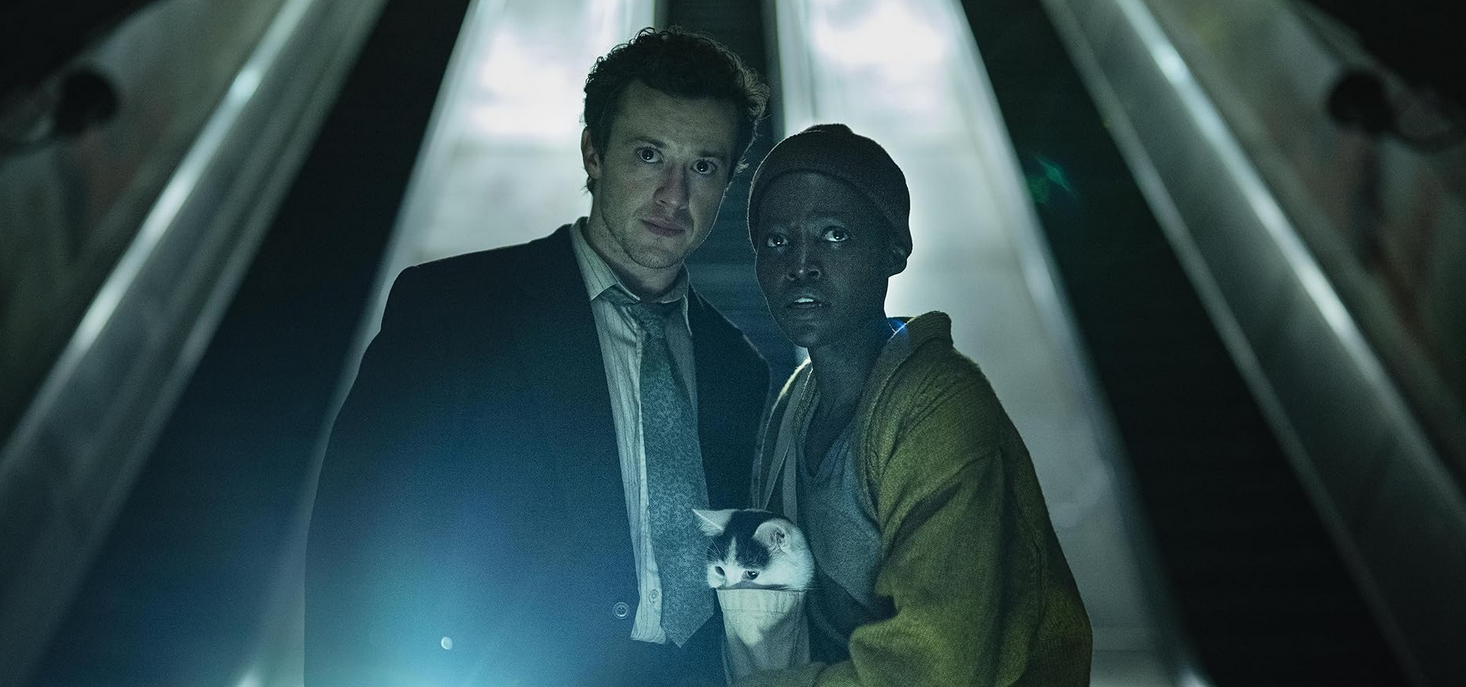
Leaving the theatre early and ushered onto their hospice bus – ‘something is happening in New York’ remarks the group’s accompanying nurse, Reuben (Hereditary’s Alex Wolff) – all hell breaks loose as Sam, her fellow patients, and New York city as a whole, is unexpectedly attacked by the monstrous alien entities that hunt their prey by sound.
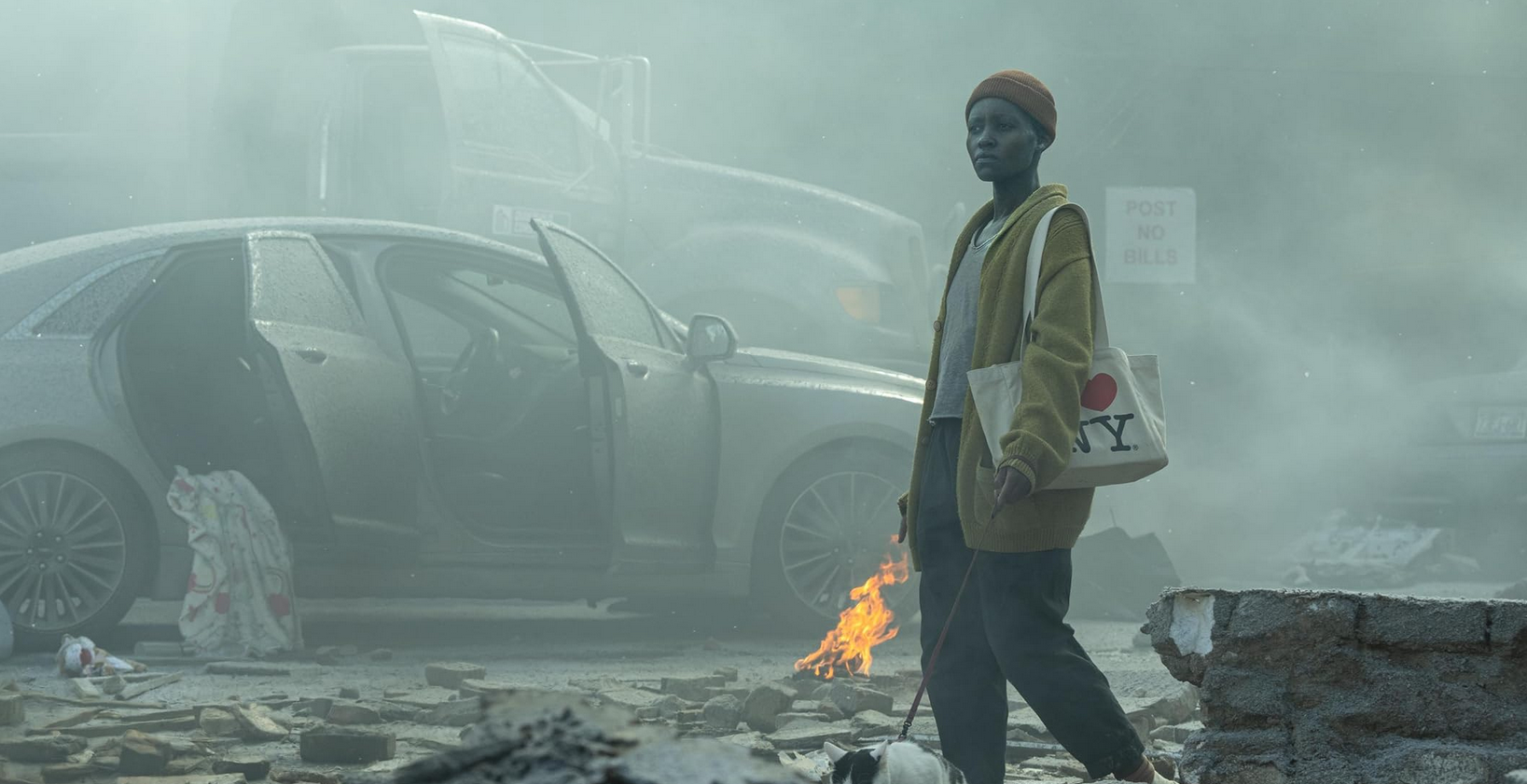
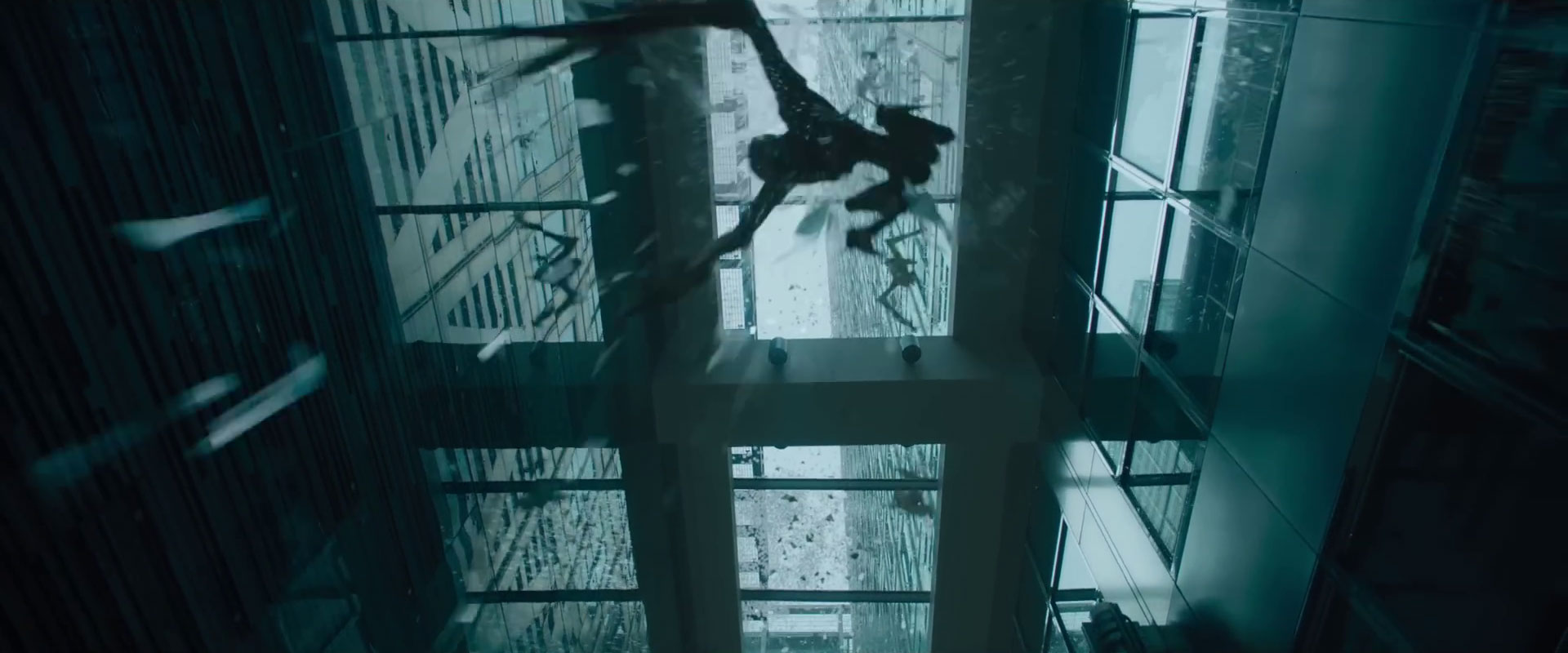
In this opening act, Day One delivers spectacle and unsettling horror on a scale unseen (and arguably unwarranted) in the previous two installments of this now expanding franchise. The sheer terror and apocalyptic imagery of the New York city street Sam finds herself on as the world around her crumbles, unapologetically mirrors the visual iconography of first hand footage captured near ground zero on 9/11, refracting that day’s visual trauma (dust covered victims desperately seeking cover from tumbling wreckage) in a manner that echoes the spree of sci-fi films produced by Hollywood in the ten or so years after those attacks (films like Cloverfield, Man of Steel and War of the Worlds). Day One ramps up the scale of the Quiet Place franchise a hundredfold, depicting hundreds of alien threats wreaking havoc on New York in comparison to the smaller-scale encounters of John Krasinski’s first film and its sequel, an expansion which can partly be accounted for by the film’s budget (this new sequel produced on a reported $67 million compared to the first film’s $17 million). Day One is the guns-blazing, dial-it-up-to-eleven Aliens, to A Quiet Place’s smaller scale creature-feature Alien.
Following the chaos of the initial attack, Sam wakes to a world of silence, sheltering with a group of terrified people in the same theatre that had provided so much joy only hours ago. Helicopters are flying across Manhattan overhead, their loudspeakers informing the residents of NYC to shelter in place and to remain silent, having quickly worked out that noise appears to attract the attention and wrath of the alien threat. From here, Sam journeys further into the deteriorating cityscape, knowing that her time is short and that she would prefer instead to die in the city in which she grew up rather than evacuate with the rest of the population.
So begins this prequel/spin-off to A Quiet Place, an entertaining continuation of the series that, whilst not necessarily breaking new ground, elevates its scope whilst maintaining at its core and like its predecessors, a very human narrative. Whilst confidently providing the expected creature-feature tropes, further aspects of the franchise’s lore are expanded upon, but never in a way that over-explains or pinpoints the central mysteries of the creatures, a narrative enigma that worked so incredibly well in the first two films and, in my view, doesn’t need to be precisely justified. The fact that three films in, we’re no more certain about the origin of these creatures, their motivation, whether they’re organised and advanced as a species or whether this something more akin to an infestation by an animalistic and instinct-driven horde, is, I think, something of a minor miracle in a sci-fi mediascape that tends toward exposition-dumps and a totalising need for ‘explanation’.
Beyond these franchise developments, director Michael Sarnoski (his first film since 2021 breakout feature Pig starring Nicholas Cage) offers a compelling and often thought-provoking addition to the Quiet Place franchise in Day One. The film is first and foremost predicated upon a captivating performance from Nyong’o who, as evidenced by her double act turn in Jordan Peele’s Us, excels in the horror genre. Similarly captivating performances from Stranger Things breakout star Joseph Quinn as Eric, a British student far away from home, as well as Djimon Hounsou reprising his role from A Quiet Place: Part II, round out the relatively small cast of protagonists, with Nyong’o and Quinn forming the heart at the centre of the film.
Indeed, if the first two Quiet Place entries were all about humanity’s and specifically the family unit’s capability for survival in extraordinary circumstances, Day One inverts this formula by aligning us with a lone character who, given her diagnosis, relates to the impulse to survive very differently. Sam had already resigned herself to the limitations of her own mortality; in the grand scheme of things, the alien threat is irrelevant to Sam’s own ticking clock. There is perhaps something a little too trite about the found-family dynamic of the film’s latter half, which sees Quinn’s Eric work to rekindle Sam’s motivation for life. However, a second sequence featuring another ‘performance’ that captures Sam’s spirit and puts a smile on her face nicely builds upon the theme of the puppet show; the two scenes working as symbolic bookends for Sam’s emotional and psychological development over the course of the film. However, it is the film’s final image, triumphantly soundtracked by Nina Simone’s anthem ‘Feeling Good’, that most clearly forefronts Sam’s newfound agency and motivation in the face of so much adversity.
In the end, we are left knowing that the events played out in Day One are still being experienced by humanity close to 500 days later, given the timeline of first two installments. Rather than acting as closure then, A Quiet Place: Day One is instead an enjoyable offshoot of a franchise that is reportedly set to conclude with Part III. It’s a stopgap designed to further explore the world of A Quiet Place without moving the overarching narrative of the franchise forward. In this respect, some longing for further detail and development may be disappointed, but I for one thoroughly enjoyed the film on its own merits, with Nyong’o – as always – stealing the show.

 Notes from the Multiplex