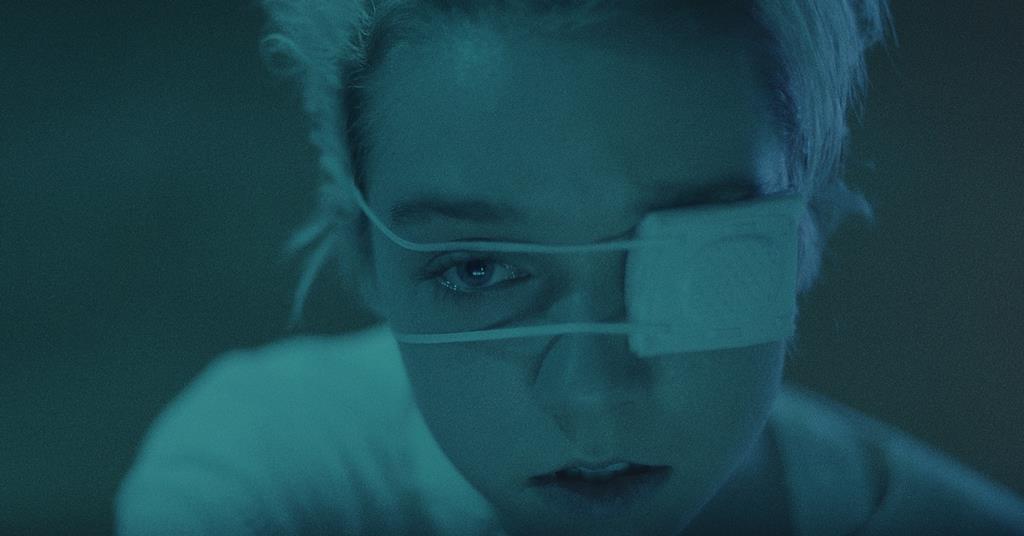

Come True is a nightmarish lo-fi horror film which explores the boundaries between dreams and the real world, occupying a space somewhere between Inception and the collective hallucinatory works of David Lynch.
Sarah (Julia Sarah Stone) is a teenage runaway who is plagued by insomnia and, when she is able to sleep, enigmatic but oppressively sinister dreams which routinely play out for the viewer at intervals throughout the film. Seeking a place to sleep for the night having left her home due to some unspecified domestic drama, Sarah signs up for a sleep clinic trial which sees her and a handful of other patients hooked up to jarringly analogue, almost Cronenbergian, machines which are said to monitor each patients’ sleep cycle. As she progresses through the trial, and her initial peaceful night’s sleep is replaced by traumatic visions and the questionable practices of the scientific team behind the trial itself, Sarah’s mental state begins to deteriorate and we the viewer are left questioning every aspect of what is seen on screen.
Filtered through omnipresent black and blue hues and a glossy and genuinely unnerving attention to cinematography which – particularly in its creation of dreamscapes – effortlessly elevates the film beyond its independent budget, Come True shifts into a devious second act which, without giving too much away, hints at a primal, unseen world which humanity encounters each night in their sleep.
The film’s resolution is bound to frustrate or perhaps even annoy some viewers, and there is a certain sense that Come True did not quite stick the landing its first two acts so brilliantly worked towards. Similarly, certain tonal shifts and momentary narrative tangents often threaten to derail the whole piece, but its overall creepy atmosphere, assisted in no small part by its central performances and the brilliantly eerie 80s inspired score from Pilotpriest and Electric Youth, results in a gem of an indie horror film that – based on its final revelation – demands repeat viewing.


 Notes from the Multiplex