
This review contains spoilers.
Despite few directing credits to his name, Foxcatcher announces Bennett Miller as a true contemporary American auteur, not yet ready to compete with giants like Paul Thomas Anderson or the Coen Brothers, but equally adept at handling the topic of that ever elusive American Dream. Yet, like those aforementioned directorial masters, the possibility of fulfilling the American Dream, in whatever guise that may take, can’t be reconciled with the dreary and colourless atmosphere from which Foxcatcher sets forth. The world Miller crafts here is one of false hopes, false prophets and a sense of physical and psychological isolation which separates each of the film’s three lead characters from each other: Mark and David Schultz (Channing Tatum and Mark Ruffalo), and the intimidatingly mysterious multimillionaire John Du Pont (an electrifying Steve Carrell).
As are many of the films currently being released in British cinemas in the run up to the awards season, Foxcatcher is based on a true story. It details the establishment of a wrestling training facility at Du Pont’s Foxcatcher farm in the 1980s, but most significantly, the relationship which developed between him and two Olympic Gold Medal winning wrestlers, Mark and David Schultz. Initially contacting Mark, Du Pont quickly draws both brothers into his own private world at Foxcatcher farm, acting alongside David as a coach for Mark and a number of other athletes as they prepare for the 1988 Olympic Games in Seoul.
Keeping Du Pont at a distance to begin with, Miller first directs our attention towards brothers Mark and David and their complex relationship. Mark, the younger of the pair, has lived his entire life in his brother’s shadow, despite their shared sporting successes. David is a far more charismatic personality and is supported by a loving wife and two children, whereas Mark in comparison appears to lead a lonely, isolated life.
However, Mark soon receives a phone call from someone representing John Du Pont, inviting him to meet and talk with the millionaire. Upon arrival, Mark is welcomed into Du Pont’s impressive, Xanadu-like estate and is quickly enchanted by his host’s tantalising financial offer and the extent of support he appears to be offering. Du Pont wants Mark to train for his upcoming wrestling competitions at Foxcatcher, and to help shape future generations of American wrestling talent. But for all the allure of Du Pont’s offer, it is clear that something amiss, something doesn’t quite add up, and through a combination of Miller’s icy cold direction and Carrell’s mesmerisingly unsettling performance, it becomes impossible to shake off the possibility of imminent horror.
Every scene Carrell’s Du Pont inhabits is airless, devoid of any humanity or warmth: qualities which he clearly lacks and seems incapable of recognising in others. In his first meeting with Mark, Du Pont rambles illogically through a number of topics ranging from patriotism to his ornithological interests, seemingly grasping on to any passing thought to use for conversation. Despite these uneasy moments, Mark falls for what could equally be perceived as Du Pont’s stirring charisma. From here, the film inches forward, step by step, developing the relationship between the two as each appear to satisfy each others needs. For Mark, this is the need of a father figure as well as someone who recognises him as an individual separate from his brother. For Du Pont, his motives are more ambiguous. It would seem the key to understanding Du Pont’s character – or at least how the film conceptualises Du Pont’s character – is underlined when he recalls in one pivotal sequence how during his childhood he only had one friend, the son of his mother’s chauffeur. Du Pont remarks how he later found out that this ‘friend’ was being paid for his companionship. The difference now is that it is Du Pont who is paying for Mark’s ‘friendship’. What is less clear is whether Du Pont is consciously aware of this and therefore complicit in the upkeep of his own illusion, or that he truly believes in the friendship he has initiated with Mark. Intentions aside, Du Pont welcomes Mark into his life and provides him with a home on the Foxcatcher estate, offers him the chance to socialise with the social elite and introduces him to the pleasures of cocaine, all whilst he is supposed to be training. At a certain point, their relationship falters and Mark’s Eden turns into a nightmare he is unable to escape from.
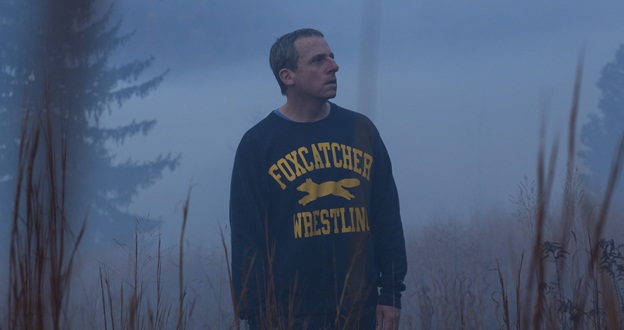
Much of the film’s power lies in the ambiguous structuring of their relationship. It moves far beyond a fractured mentor/student dynamic into something deeply psychological. Du Pont has a multitude of different meanings to Mark – coach, leader, father, brother – whilst Du Pont’s motives are never as clear, which makes the character seem all the more dangerous. All this makes for a brilliantly compelling and intense character study in which the dynamics of trust, friendship and duty between people are all pushed to their limits and ultimately destroyed. But the film never places judgement; Du Pont is never positioned as the villain of the piece but as a fundamentally complex individual fraught with debilitating psychological issues resulting, no doubt, from the unique characteristics of his isolated childhood. His desire to become, not just a coach, but a ‘leader of men’ is an impossibility, an inevitable failure of character that will prove to reap horrific consequences for those who counter his deep-seated, rhetoric-driven goals: to be a hero and to see America ‘soar again.’ Foxcatcher at its core is a shocking depiction of an individual who sees a realisation of the American Dream as an actual possibility and, perhaps because of this belief, is corrupted by his own twisted perseverance and determination.
Miller’s mastery is in the film’s slow-burn pace and enigmatic build up, emphasising his characters’ inability to communicate with one another and what has been left unsaid. In fact, the film is a frighteningly quiet affair; even Arvo Pärt’s ‘Für Alina’, which underscores some of the film’s most crucial moments, is a piece which hinges upon the haunting silence heard between its notes which emphasises a sense of desolation through its sparse and delicate instrumentation. Pärt’s composition is very much an echo of Miller’s direction here. Minimal and chilling, but precise. However, Miller’s prowess as a director is underlined most resoundingly in an early sequence which eerily maps out the trajectory of the film as a whole. Mark and David begin a training session, grappling with each other in a timid and very subdued manner, stretching out each other’s limbs whilst easing into their combative stances. Quietly, and then emphatically, their training session progresses into heated, primal conflict which leads to a violent outburst and a blood stained David. As the film itself progresses, this narrative arc is replicated on a massive scale, leading in all of its tension and dread towards this true life story’s startling conclusion. This isn’t the American Dream, but a natural progression towards a very American death.



 Notes from the Multiplex