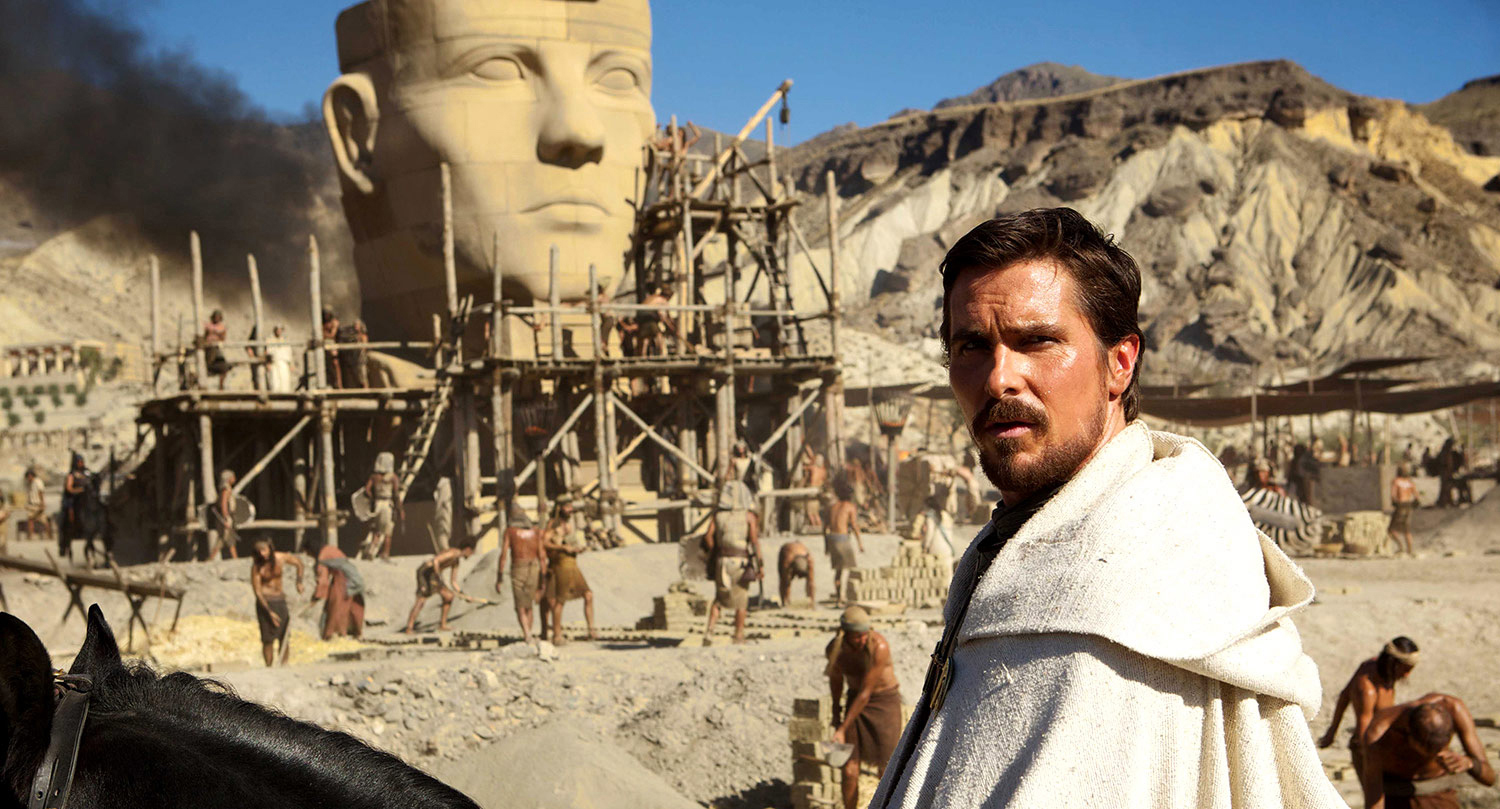
Like the apocalyptic CGI storm clouds which appear to be sentiently competing for as much screen time as star Christian Bale, Exodus: Gods and Kings is a visually sublime, even beautiful film to watch: filled with the kind of gargantuan cinematic imagery that would make D.W. Griffith or Giovanni Pastrone proud. Ultimately, however, it’s as empty as that seemingly menacing sky; devoid of characterisation or any original premise in adapting the story of Exodus, other than the confused possibility that the plagues suffered by Egyptians could be explained by rational thought. Other than that, this is the Exodus story from beginning to end, but told with the widescreen bravado of director Ridley Scott, who seems all too ready to engage the spectator’s eyes but not their mind.
Fearful of a prophecy which claims that the saviour of one man will become a leader himself, Ramesses (Joel Edgerton), exiles Moses (Christian Bale), who saved his life during battle, after it is later discovered that he is a Hebrew. Moses spends the next nine years living a quiet life with his wife and son, only to receive a vision from God who, in the guise of a small boy, tells him to lead a Hebrew revolt against Egyptian rule, freeing them from the tyranny which has enslaved them for over 400 years. Moses duly returns to train an unskilled army in the art of warfare, who then begin to sabotage Egyptian property and power. Their revolt is then assisted by a series of ten plagues sent by God, including infestations of frogs and flies, all rendered with overblown CGI pomp and splendour. After the death of all first born Egyptian children, Ramesses, devastated by the death of his own son, instructs Moses and the Hebrews to leave Egypt. However, Ramesses soon decides to chase down the escaping population with Egypt’s army behind him, only to be defeated by the Red Sea, which the Hebrews are able to cross safely.
The question my mind fixated upon after leaving the cinema was: who is this film targeted at? Certainly, it’s blockbuster production and scale, not to mention the inclusion of Christian Bale and Breaking Bad fanboy favourite Aaron Paul as Joshua, would suggest the film is longing for the pocket change of that much sought-after younger male demographic. Yet for a film which at first glance promises biblical blockbuster action, such moments are actually few and far between. It’s dialogue-heavy sequences seemed to bore those around me in the cinema, which included a father and his young children who, between bouts of popcorn shovelling, appeared to be confused by any aspect of the plot which wasn’t Christian Bale screaming at people and/or killing them. Similarly, once they had all jumped with joy after receiving affirmation that, yes, that was in fact Jesse Pinkman, they were quickly left disappointed by Joshua’s complete lack of use within the narrative other than to receive orders from Moses.
Excluding Bale and Edgerton, the same can be said for every other prominent actor within the production, with the likes of Sigourney Weaver appearing at a few random junctures to cover a few speaking parts necessitated by what I would like to imagine was a scriptwriting session in which the conclusion was drawn that there needed to be some middle-ground between Bale shouting and Bale smirking. Ben Kingsley similarly performs a disappearing act after his turn at the prophecy proclaiming Nun is completed. For all the controversy surrounding the casting of white actors in the film, their actual use is pretty minimal; a few glimpses of mostly silent actors with some name-recognition used to fill out the cast list. None are given anywhere near an amount of adequate screen time to stretch their acting muscles, despite the film’s collected pool of acting talent.
At the end of the day, Exodus: Gods and Kings simply feels too generic and forgettable: another lacklustre blockbuster which spends too much time and money on visuals and not enough on character or narrative development.



 Notes from the Multiplex