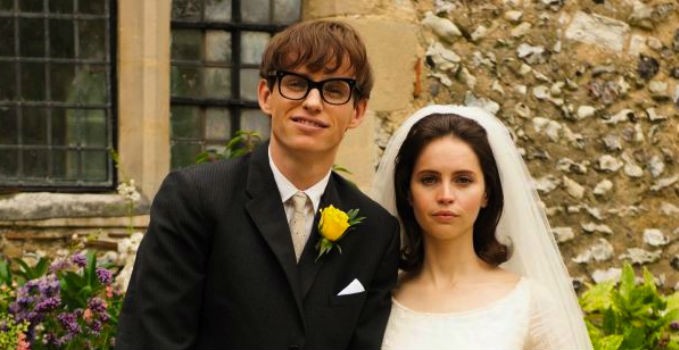
Eddie Redmayne shines in this touching romantic drama about Stephen Hawking and the relationship he had with his first wife Jane (Felicity Jones); a portrayal which will surely stand him out for recognition when the Oscars roll around. The Theory of Everything concerns Hawking’s personal life rather than his science, and unlike the other recent foray into the life of a British scientific genius, The Imitation Game, it is all the better for limiting itself to this single train of thought in its execution. In fact, its hard not to compare the two films given their close release dates, the fact that Imitation Game star Benedict Cumberbatch has also had a turn at Hawking, and that both films make metaphorical links between their respective subjects and the scientific ideas which came to dominate their lives. Like the notion of a degenerating black hole and the idea of turning back the clock which prompts Hawking’s first significant thesis, the man himself is confronted by the degenerative effects of the motor neuron disease which initially threatened to put an end to his life within a span of two years. By comparison, Tyldum’s film (which is also tipped highly for award season recognition) struggles to establish the same sort of link between notions of determined, pre-programmed instruction sparked by Turing’s concern with A.I. and ‘digital brains’ and his fight to conceal the man he really was; a comparison drawn more effectively by Andrew Hodges in his Alan Turing: The Enigma, but handled less than adequately by the Cumberbatch vehicle which succumbs all too easily to needlessly fabricated dramatic ‘twists’ and plotting.
The Theory of Everything, in my mind gets this kind of biopic right, offering an intimate portrayal of an important scientific mind and a relationship brought to its knees by a cruel and unforgiving disease. First and foremost, the film emphasises the human drama of Hawking’s life as the film’s central concern. Yes, the science plays an important part, but pales in comparison to the emotional impact Stephen and Jane both face as each become more distant from one another in reaction to Stephen’s growing fame and dependency on others. This isn’t surprising given that the film was based on a biography written by Jane Hawking herself. The dramatic arcs come, not from scientific revelation, but at the various junctures which mark Hawking’s personal life. From his early days as a Cambridge post-graduate attempting to pin down the subject of his PhD thesis, the film charts his diagnosis, his first scientific accomplishments, his marriage, the birth of his children and, inevitably, the progression of the disease which gradually robbed him of his ability to walk and later speak (after a pneumonia diagnosis called for a tracheotomy).
As is said by Stephen’s father in response to his son’s initial diagnosis: this won’t be a fight but ‘a very heavy defeat, for all of us.’ But surprisingly, as everyone is aware, Hawking defied every expectation and went on to become one of the most respected scientists in his field, a trajectory Redmayne plays with unbelievable conviction, reacting to every adversity, setback and triumph with a performance that is simply enthralling: simultaneously both physical and psychologically nuanced. Even as the limits of his physical performance are pulled back as dictated by the nature of Hawking’s illness, Redmayne is still able to communicate so much. A startling climactic montage which literally rewinds the film does much to highlight the transformative mastery behind the young actor’s ability as an actor. Performance is really where The Theory of Everything shines and that goes for its entire cast. Whilst nothing revolutionary or original is particularly taking place in regard to its use of cinematography or narrative, the enchanting central performances of its lead players are as intense and as heartfelt as those offered by any other film currently on the campaign run before award season. The quality of such performances also outweigh the potential damage done by one, in my opinion, misguided sequence near the film’s conclusion which sees Hawking daydream about what it would be like to walk, and that really is the only glaring fault I can find with The Theory of Everything. I understand why the scene was included, but it does come over as somewhat ostentatious. Above all, however, The Theory of Everything is a heartbreaking but triumphant drama about a relationship which was forced to overcome overwhelming odds but fell apart in the process, but a relationship which meant so much to those involved.


 Notes from the Multiplex