The following is part of a series on Powell and Pressburger films being posted this week on Notes from the Multiplex.
This is most likely an observation which has been written about elsewhere, but nonetheless: one thing which struck me when watching Powell and Pressburger’s hypnotic masterpiece The Red Shoes again recently, was the film’s clear indebtedness to German expressionist cinema of the 1920s. In particular, I’m referring to the film’s famous sequence in which the performance of ‘The Red Shoes’ is actually depicted for the first time: a mesmerising tour de force of technicolor cinematic marvel. The Red Shoes tells the story of young ballerina Victoria Page (Moira Shearer) and her rise to fame whilst suffering under the manipulative instruction of ballet company director Boris Lermontov (Anton Walbrook). Ultimately a tragedy, The Red Shoes’ finest moment is to be found in the aforementioned ballet sequence, which lasts almost 15 minutes.
The beauty of the sequence lies in its unabashed departure from the theatrical stage, taking flight into a realm of highly edited/stylised cinematic wonder. Rather than taking the simplistic ‘filmed theatre’ approach to depict such a scene, the film opts to forgo the rules of physical reality. Whilst the sequence begins as if we are part of the audience, watching the performance as it unfolds on stage, Powell, Pressburger and cinematographer Jack Cardiff quickly invite us to leave reality behind, taking us into a dazzling fantasy world of kinetic visual trickery and emotive dream landscapes.
But this dreamworld itself it tinged with a familiar feeling – a familiar aesthetic. It’s vibrant motion and use of special effects calls to mind films like Murnau’s Sunrise, for example. But it is also a place in which the psychological tensions of Shearer’s character become manifest within the environment. The fairytale story of the ballet merges with Vicky’s own perception of the world around her, creating something far more sinister than she could have imagined. Here, the the identities of those she knows and loves slip into other forms. Such forms are uncannily human whilst also being simultaneously monstrous.
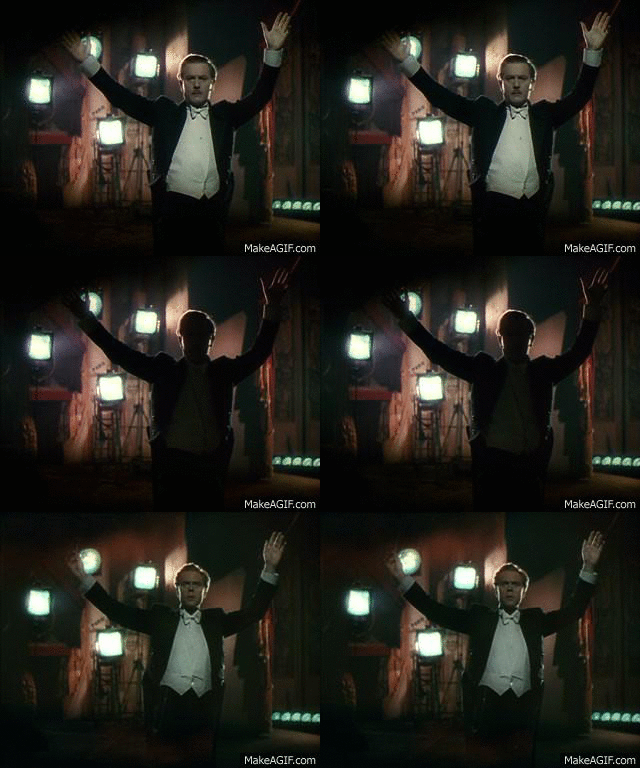 The symbolic presence of both Lermontov and Julian (Marius Goring) within, what we presume to be Vicky’s nightmarish vision of The Red Shoes performance, has an effect which is not lost on the viewer. In Vicky’s confused state, her emotional bond to both characters, as well as her own perception of them, has become fragmented. The mirroring or doubling of identity combined with the apparent horror of such an occurrence, brings to mind films like Fritz Lang’s Metropolis and Brigette Helm’s character Maria, and similarly calls back to other tales of gothic horror such as The Strange Case of Dr. Jekyll and Mr. Hyde.
Furthermore, moments prior to the face-on shot of the transforming figure seen above, we can also see the clear influence of Murnau’s Nosferatu impinging onto the scene in the shape of the shadowy power which appears to threaten Vicky.

 Once she sees this strange apparition, which first appears in the guise of Ljubov (Léonide Massine) only to then transform into both Lermontov and Julian, Vicky’s grip on reality begins to fade and, rushing forth into this figure, she is transported into a world far removed from that of the stage she occupied just moments before. The world she enters into is one of twisted shadows and distorted images, of bold colours and darks recesses. It occupies a landscape immediately reminiscent of the contorted images of The Cabinet of Dr. Caligari, with its jagged, near-alien skyline.


Of course, it should also be noted how there is absolutely no dialogue within the performance sequence itself, accompanied only by Brian Easdale’s marvelous score. The sequence, in this sense, works much like a silent film would do, communicating narrative and emotion through the power of the image rather than dialogue. In the case of The Red Shoes, much like German expressionist cinema, the audience is treated to an energetic sensory experience predicated upon the power of the image and rooted in poetic metaphor and symbolism rather than realism. It is a sequence of dreams rather than reality, and for its part, one of the most delectable moments of cinema Powell and Pressburger ever put on screen, but one clearly influenced by past masters of expressionist cinema.

 Notes from the Multiplex