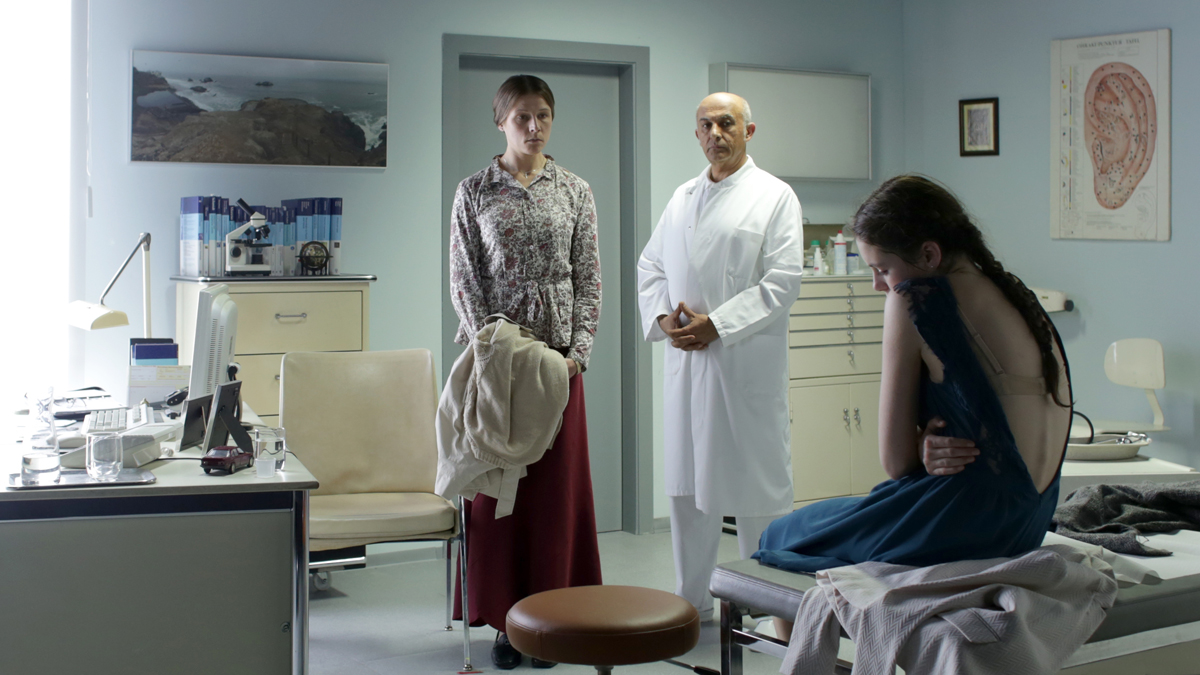
Compared to the recent film Ida, which also looked at similar subject matter regarding the demands put upon a young girl by her religious beliefs and the institution of the church, Stations of the Cross is an even more minimalist affair than the aforementioned Polish work, in keeping with its central character’s simple life of sacrifice and avoidance of temptation. In fact, Stations of the Cross is entirely constructed around fourteen scenes, each of roughly the same length which make up the film’s near-two hour running time. These fourteen vignettes are presented to correspond with the fourteen stations of the cross (artistic renditions of Christ carrying the cross to the crucifixion), the first being: Jesus is condemned to death. In a style reminiscent of something like Michael Haneke’s Code Unknown, each scene presents a neatly executed dramatic arc, cutting to black once its message has been effectively put across to the spectator. From the film’s opening moments, we know that this will be a story of faith and inevitable sacrifice, but for all of the film’s apparent surface simplicity, there exists in Stations of the Cross an engrossing, astutely executed drama about a girl named Maria who has only one desire: to be with God.
Maria (Lea van Acken), aged fourteen, is part of a fundamentalist Catholic church, separate from the Vatican, which is said to have departed from Catholic tradition. Maria is also about to take communion, which she has been eagerly awaiting. The oldest child of her family, an intense pressure is placed upon Maria to uphold the values of the Catholic church and respect both her father and mother. Whilst Maria’s father remains a quiet, even timid figure, her mother (Franziska Weisz) is a force to be reckoned with. Possessive, controlling and willing to isolate Maria from any outside influence she deems ‘satanic’ or improper (including jazz and soul music), Maria’s mother (who remains unnamed) slowly drives her eldest child into a downward spiral of exhaustion, guilt and illness. Whilst she sees it as her motherly duty, and Maria is only too ready to respect and honour her decisions and behaviour as the sixth commandment dictates, Maria’s mother becomes something of the piece’s antagonist, primed to make uncomfortable audiences wince at her authoritarian control.
There is something to say, however, about how different audiences will react to Stations of the Cross, as I would imagine any reaction will rest upon the spectator’s own religious beliefs (or lack of them). Personally, Stations of the Cross offered a horrifying insight into a life ruled by illogical dogma and contradictory rhetoric, but it should equally be appreciated how others may see the film and (without spoiling) some specific plot points as a genuine endorsement or validation of religious belief.
Whilst the diversity between shot compositions, visual setups and transitions are admirable within its very limited framework, Stations of the Cross is a film of ideas rather than visual flair. Although its thematic concerns remain its focus and strength, its weaker moments become particularly apparent when, in certain sequences, the positioning of characters and their movements within the shot and throughout the take betray a certain theatricality, which appears to be all too self-aware of the fourth-wall, which in other sequences it is able to disguise more skillfully. That said, Stations of the Cross is sure to leave the viewer thinking for days on end about notions of faith, devotion and sacrifice, an accomplishment bolstered by its intriguing form, effective hard-hitting drama and a breathtaking central performance from newcomer van Acken, who deservedly stands out for award recognition.


 Notes from the Multiplex