This post is the first in a series of posts this week on the films of Michael Powell and Emeric Pressburger. Check back every day this week to read more about the legendary British film-making duo and follow @MultiplexNotes on Twitter to get all the latest updates.
Said to have been a great influence on the likes of Martin Scorsese, the duel sequence from Michael Powell and Emeric Pressburger’s The Life and Death of Colonel Blimp (1943) is a scene which resonates throughout the history of cinema: a perfectly calibrated introduction to a relationship formed between two characters whose lives will intersect across decades and during two of the most violent conflicts of the 20th century. But despite the scale of the warfare and destruction that is to come, these two professional soldiers, Clive Candy (Roger Livesey) and Theo Kretschmar-Schuldorff (Anton Walbrook), are first introduced to one another in the most unceremonious of settings: an Army gymnasium. Here is that iconic scene:
Scorsese once commented that, for him, ‘the most important thing is the humanity of the film, the relationship between the characters.’ Despite what traditional narrative would dictate, and what is still nonetheless an important component of Blimp, the central relationship examined by Powell and Pressburger aren’t those representing Candy’s lost love of Edith Hunter (Deborah Kerr) within the subsequent manifestations of her character, but the complicated relationship formed between Candy, an Englishman, and Schuldorff, a German. Here, in a sequence set years before the outbreak of WWI, a Brit and a German come face to face with each other, tasked with defending the honour of their respective armies after Clive’s youthful naivety causes something of a diplomatic crisis between the two nations.
It is vital to remember that The Life and Death of Colonel Blimp was released during the height of WWII, when British propaganda, as well as other films like Went the Day Well?, were keen to paint the differences between the allied forces and the enemy in a reductive black and white. Blimp (as well as earlier Powell-directed films like 49th Parallel) was unusual in this regard for portraying a German soldier, Anton Walbrook’s Schuldorff, as a sympathetic character. The film was also exposed to criticism from the highest levels of British political office, with Prime Minister Winston Churchill notably objecting to the film’s depiction of an apparently out of touch Clive Candy (whom Churchill took to be a caricature of himself), as well as the film’s satirical approach to the portrayal of the British Army and political realm as a whole.
Whilst such equality in the depiction of British and German characters proved controversial and even subversive at the time, the retrospective eye can only admire the film’s claims for a shared humanity between people of all creeds and nations, transcending artificial borders and constricting political ideologies. In this sense, it was a remarkable feat accomplished, that Powell and cinematographer Georges Perinal were able to extend this sentiment of equality into the construction of Blimp‘s duel scene, the pivotal sequence in which Englishman and German come face to face for the first time, supposedly to confront an ‘enemy’, but in reality confronting another human being.
The sequence begins in the absence of Walbrook’s character who has, at this point in the film, not been present at all. Candy, meanwhile, is learning first hand about the contrived nature of the duel. He asks, ‘why wasn’t I allowed any breakfast?’ only to be countered by the reply that ‘the book says not’: an unquestioned adherence to a ‘rule’, the type of which that was once defiantly ignored by Candy and will later be ignored by the Home Guard forces who ruthlessly place tactical ingenuity before integrity and respect.
On the hour precisely, Schuldorff arrives at the hall accompanied by two other German officers…
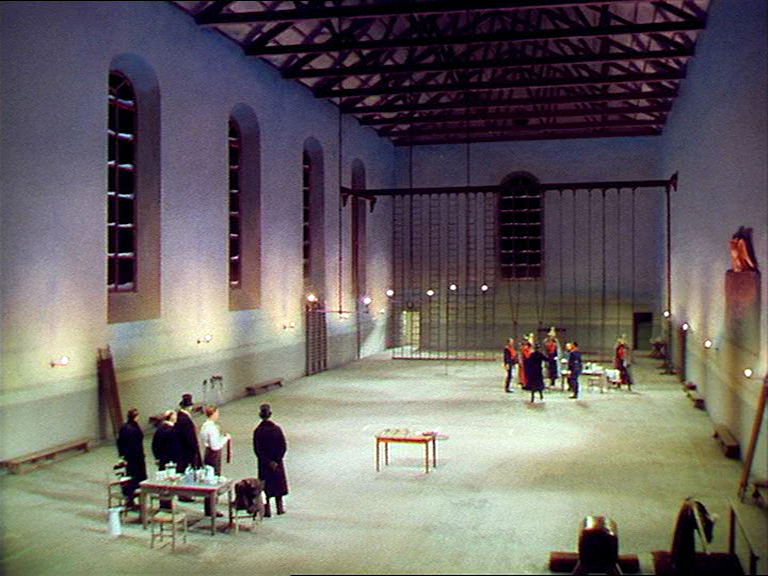 Initially, the two factions are clearly separated within the space of the hall, each looking on at each other in apprehension of what is to come. Candy comments on the choice of sabre, hoping that his is a ‘nice light one.’ His supporting officer retorts that – ‘all sabres weigh the same‘ – a remark which emphasises the significance of equality within the scene, suggesting that each combatant has a tool of equal capability, be it the ability to defend themselves, wound, or even kill their opponent. What matters isn’t the sabre itself, but the man who holds it and their approach to the task at hand. Are they able, or perhaps even capable of recognising the shared humanity present within their supposed enemy? Can they see the same fears, the same desires in the man they face?
The gulf of space created in the earlier shot discussed above is soon removed by a series of shots which compress the action of the space down to almost claustrophobic depths, whilst simultaneously crafting that first connection between Candy and Schuldorff.
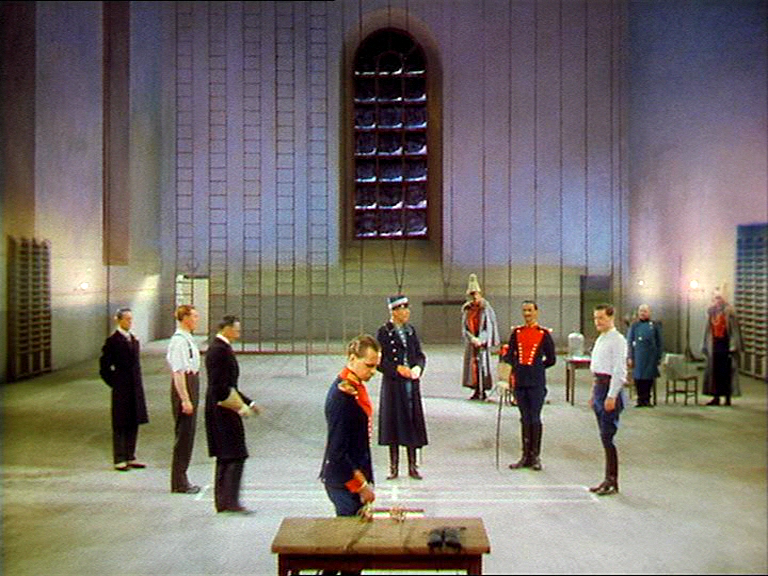

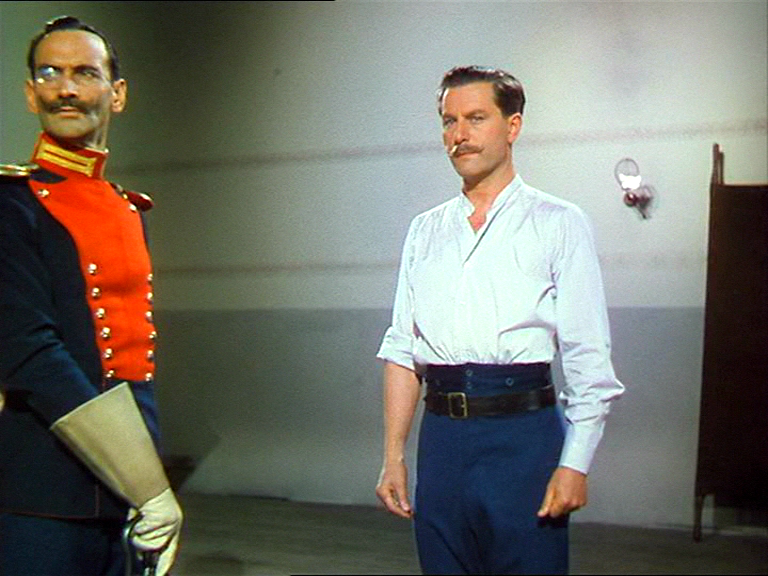
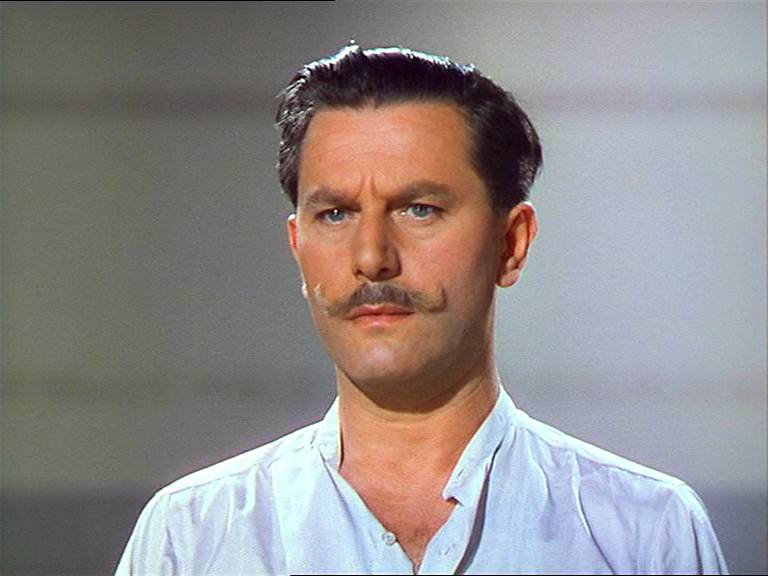

As the camera moves closer and closer, placing both Candy and Schuldorff in almost identically framed shots, a symmetry is created between the pair, almost as if they were one of the same: a mirror image of each other separated only by the colours of the flag that their respective nations and armies uphold. It seems Candy is the first to recognise the absurdity of the situation, smirking in a manner which betrays his indifference to the whole affair, leaving Schuldorff confused. Neither character has any real stake in the duel, coerced into the battle by way of their loyalty to a tradition of gentleman soldiers and the upkeep of military honour, an antiquated ideal which will later be questioned in light of the dishonorable tactics employed by the Nazis.
To paraphrase from a film released the year before Blimp, this sequence marks the beginning of a beautiful friendship, one which transcends the abstract concepts of national or political identity. Though its roots lie in conflict, its future lies in peace and, more than that, an understanding that what defines humanity can only be found underneath the flags and uniforms of warfare, and not the other way around. Schuldorff is not Candy’s enemy, but his equal, and the execution of the duel sequence in The Life and Death of Colonel Blimp epitomises this beautifully. As Scorsese said, it is the ‘humanity’ of the film which is most important to recognise.

 Notes from the Multiplex