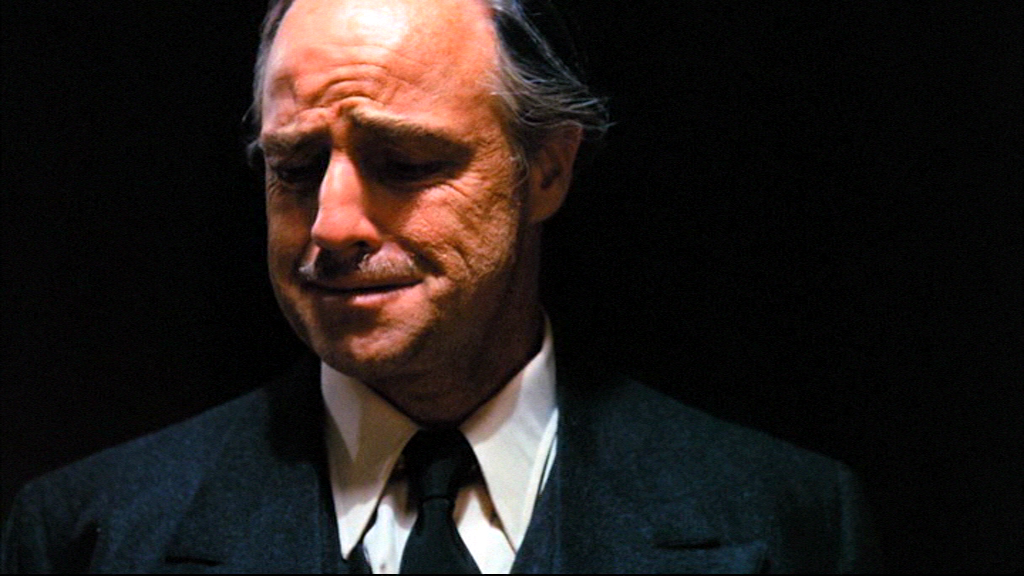
A new feature: ‘Frames in Focus’ will be a short piece of writing looking at a singular frame within a film and the artistry behind its composition. To begin is this still from one of American cinema’s greatest masterpieces, The Godfather.
At this point in the film, the Corleone family is in something of a nosedive. Vito (Marlon Brando) has survived an assassination attempt, but with severe consequences. Michael has fled to Sicily to hide after murdering drug-lord Sollozzo and Police Captain McCluskey. Then, in one of the film’s most memorable sequences, Sonny Corleone (James Caan) is gunned down at a toll booth whilst driving to his sister’s home: a cold-blooded massacre.
But I’d like to draw your attention to the sequence which occurs a few minutes after the depiction of Sonny’s murder, in which Vito and Tom Hagen (Robert Duvall) visit the morgue at which the Godfather’s dead son now lies lifeless.
Almost as if being interrogated by the police under a harsh spotlight and placed in front of a completely black background, this shot of Vito Corleone emphasises nothing other than Brando’s heartbreaking performance: not just simply of a general who has lost his foot-soldier, but of a father who has lost his son. In this medium close-up, Coppola and cinematographer Gordon Willis detach Vito from his surroundings, as if placing him in some abstract space where there is nothing else to confront but the brutal fact that his first-born son is dead. In this moment, Vito is humanised and made sympathetic to a degree to which he has not been before. No parent should have to bury their child.
It is a shot which echoes those of the film’s iconic opening sequence which similarly utilises shadow and darkness. But here, Vito is no longer in control of the situation: no longer the master of all he surveys. This is the beginning of the end.

 Notes from the Multiplex