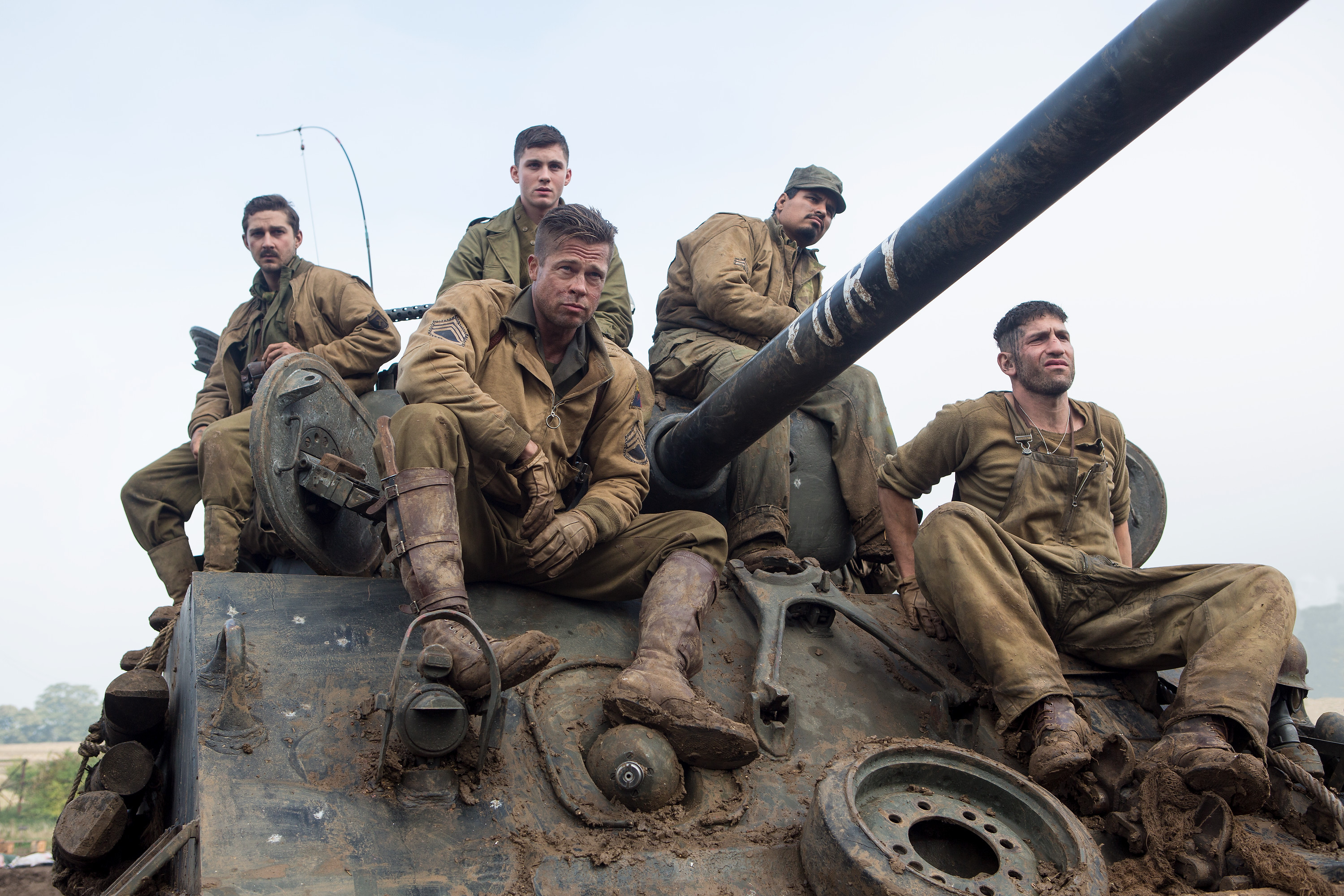
On the spectrum of films depicting WWII, David Ayer’s Fury leans more toward the dream-world of Tarantino’s Inglourious Basterds than the documentary realism of Spielberg’s Saving Private Ryan.
Arguably, this initial positioning of the film’s aesthetic conception may have something to do with the casting of Brad Pitt in the lead role as Don ‘Wardaddy’ Collier, a diluted but definite echo of his Lt. Aldo Raine character in Tarantino’s war epic, featuring the same southern drawl and scarred body. But Ayer’s film delves more into the realm of nightmare rather than Basterds’ orgy of history re-writing wish fulfillment.
The film sets forth with the five man operated tank nicknamed ‘Fury’, helmed by Wardaddy and operated by a ragtag collection of the usual military misfits: the bible preaching Boyd (an admirably good Shia LaBeouf), the unhinged Grady (Jon Bernthal) and the disillusioned Gordo (Michael Peña). After the death of their gunner, a young army typist named Norman (Logan Lerman), who is somehow re-assigned to the tank division despite his inexperience, enters into the band of brothers, unprepared and unwilling to fight in the ‘kill or be killed’ chaos of war.
These are the final days of the war itself, and the group are exhausted, long ago desensitised to the violence and destruction they have experienced over the course of the North African campaign, right through to their present march towards Berlin. The film’s opening act aggressively attempts to match these soldiers’ psychologically crippling over-exposure to the violence of warfare with that of the spectator’s own experience of the film: beating down both our spirit and strength with its explicit on-screen endurance test of war’s apparently limitless horrors. But whereas Spielberg began his vision of the war on its most devastating note with Ryan’s infamous depiction of the D-Day landings, only to scale back the story from the multitude to the individual, Ayer’s film, and particularly its final act, is a rampaging escalation of war’s fury.
Tasked with eliminating the remaining Nazi presence, moving from town to town in a seemingly never-ending cycle of sudden conflict and momentary, paranoid respite, the crew of the Fury fight on in hope that they will one day return home, whilst flippantly repeating the mantra that their role in the army is ‘the best job they ever had’. Whilst this comment portrays the incomprehensibility of war well, the core of the film’s message is brought home by Michael Peña’s character during the second act, when the crew find themselves enjoying the spoils of war in a town they have just liberated from the Nazis.
Recounting the days after the D-Day landings, Gordo tells of how the Fury crew came across a Nazi cavalry division. For three days, he reveals, the men did nothing but kill horses, from day to night. ‘Your eyes see it’, he says, ‘but your brain can’t make sense of it.’
As the film transitions from the second to third act, the truth of this statement is reflected in the film’s descent into its nightmarish final stand, the crew fighting against a horde of German opposition, bathed in the hellish glow of a fire erupting around them. Smoke, flames, blood and bullets fill the air and gradually the screen amounts to an abstract reflection of the conflict where both American and German soldiers are little more than silhouettes, collapsing the differences between each opposing faction to draw out their shared humanity and highlight the futility of the war in all its bloodshed and horror. The excess of this sequence and the film’s previous depictions of the conflict in which graphic violence is always a prominent feature, undoubtedly surpasses the boundaries of the genre’s conventional verisimilitude, and have understandably left some commentators alienated, unable to relate to what’s on screen. But like the nature of war itself, the events of the film can be seen, but not necessarily comprehended by rational thought.
Fury’s presentation of the war through its slightly distorted sense of reality therefore distances itself from the Spielbergian mold of war-film. Of course, ‘war is hell’, but the lucidity of Fury’s final act almost hints at the presence of something demonic: even if a literal manifestation of such evil never shows itself, it equally never feels far from the edge of the screen.

 Notes from the Multiplex