Last summer, comedian and political commentator Jon Stewart temporarily stepped away from The Daily Show, leaving British comedian John Oliver to unexpectedly cover some of 2013’s most important news items including Edward Snowden’s revelations about the US government, and of course, the misadventures of Antony Weiner.
Whilst Oliver used the opportunity as a stepping stone towards the creation of his own show Last Week Tonight, Stewart used his time away to direct his first feature film, which had its UK premiere at the London Film Festival earlier this month. The result, Rosewater, depicts the true-life story of Iranian journalist Maziar Bahari, who was imprisoned whilst reporting on the Iranian election of 2009, adapted from his own memoir Then They Came for Me, which documents the 118 days he spent behind bars.
Beginning with a raid on Bahrai’s home, Stewart charts the ordeal from beginning to end with a confidence rarely found in first-time directors. In fact, it is Stewart’s relationship with the event which clearly marks him out as one of the few people able to tell Bahari’s story, as it was Bahari’s participation in a small segment for The Daily Show, which partly resulted in his arrest. Anyone who has watched Stewart’s programme quickly understands that much of its humour comes from his satirical approach to politics and current affairs, highlighting the absurd and surreal aspects of contemporary American life. However, the interview with Daily Show correspondent Jason Jones, which Bahari saw as little more than harmless fun, came back to haunt him when it was used against him by the Iranian government as evidence of him being an American spy.
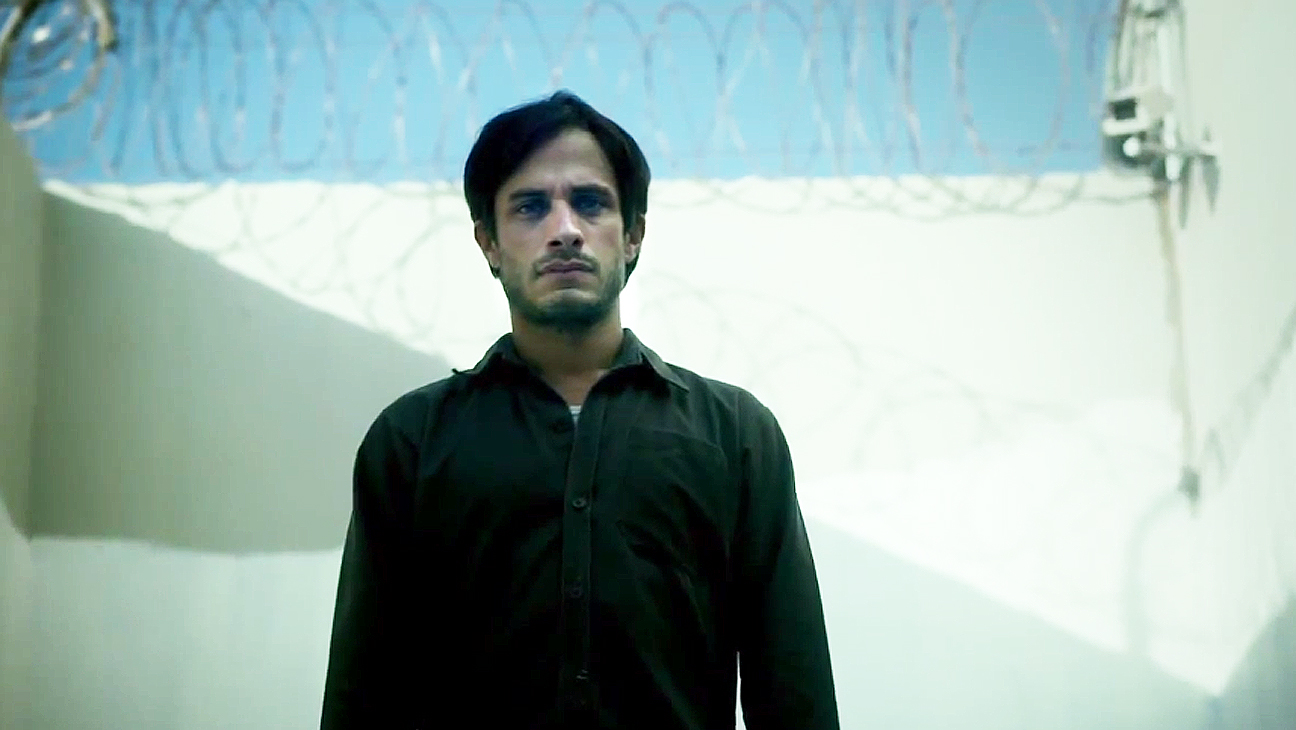
The absurdity of this kind of paranoid mindset is established by Stewart in the film’s opening moments when the ‘specialist’, who is later put in charge of Bahari’s interrogation, comically holds up copies of The Sopranos and Visconti’s La Terra Trema as evidence of subversive contraband – ‘porno’ it is claimed. After depicting the days leading up to his arrest, during which the country experienced a wave of social unrest after the re-election of president Mahmoud Ahmadinejad, Bahari, played with conviction by the magnificent Gael García Bernal (NO, Amores Perros), is imprisoned and is subjected to interrogation and torture, an experience which both his father and sister also suffered through.
Despite the film’s fundamentally serious subject matter, Stewart’s real achievement is the harmonious balance achieved between drama and comedy that is maintained throughout Rosewater’s running time, which stands at a compact 100 mins. Transferring his skills as a satirist on The Daily Show to a big screen narrative, Stewart demonstrates his ability to make his audience both laugh at times or shock them when the severity of the situation calls for such a reaction. In this sense, Rosewater’s evident accessibility highlights Stewart’s clear purpose to present this story to the largest demographic possible, fortunately without ever trivialising the material. Understandably, aspects of Rosewater may not be familiar to Western audiences and yet cultural difference and the potential gaps of knowledge in Stewart’s primary fan-base of young American men is reduced to a minimum through the film’s, perhaps at times, over-expository voice-over narration and dialogue.
It is similarly refreshing to see a drama such as this told in such a cleverly stylised manner. Like NO’s ‘visually authentic’ treatment of the campaign against Chilean president Augusto Pinochet, filtered through the visuals of fuzzy 80s videotape, Rosewater makes use of images incorporated into the scenery of Bahari’s life in order to visualise his memory and in one particular sequence, emphasises the importance of Twitter during the period of the country’s social upheaval by having trending hashtags and messages literally projected onto the city of Tehran: extending the film beyond the commonplace practice of shaky-cam ‘gritty realism’ and muted colour tones.
Whilst some may find fault with the potentially ‘cliched’ aspects of Rosewater’s execution, I for one found the film to be a formidable first effort from Stewart, communicated with a boldness and level of visual flair by a talent who I hope to see in the directing chair again as quickly as possible, even if that does mean another spell of absence from his regular day job.


 Notes from the Multiplex