Paul Thomas Anderson’s The Master portrays the corrupting influence of power within the context of a Scientology-like movement in the post-WWII era. The eponymous Master of this mysterious institution known as ‘The Cause’, where regression therapy and bizarre mind-expanding exercises are a day-to-day practice, is the charismatic Lancaster Dodd, played by the late, great Phillip Seymour Hoffman. Opposite Hoffman is the equally brilliant acting talent of Joaquin Phoenix, who embodies the child-like drifter Freddie Quell: weary of the world after serving in the war and ready to latch on to anything that promises answers to the questions that conventional society can simply no longer provide.
Over the course of the film, Dodd slowly indoctrinates Quell through his charm and showmanship, only to lose him when The Cause’s ideas don’t exactly pan out. However, Dodd’s initial ability to ensnare Quell, and his continually increasing control over the veteran’s life is reflected in and developed by Anderson’s framing of the characters.
For a film called The Master, Anderson’s deployment of cinematography rarely relies on master or establishing shots, instead framing its characters in a multitude of tight, often claustrophobic close-up shots in shallow focus. The Cause’s arrival in New York, for example, isn’t announced by the conventional use of establishing shots highlighting the sights and sounds of the metropolis. Instead, this is a film of character rather than location or space: of identity and persona and the relationships between characters and how they develop and deteriorate.
The relationship between Dodd and Quell obviously takes centre-stage, and in this sense, the development of their initial relationship and Dodd’s increasing level of control over his new pawn can be seen in two separate scenes, the latter of which being an almost near mirroring of the first, albeit with some significant changes.
Drifting around California, Quell, drunk and on the run after being accused of killing a man, stows away on small ship docked in San Francisco. Cut to the morning after, and Quell is called by the captain of the ship to his quarters, where he finds none other than Lancaster Dodd waiting for him. This, the first on-screen encounter between master and servant is clearly of importance in establishing their relationship. Discussing Quell’s new role on board the ship as a seaman after ‘applying’ for the job in his drunken state the night before (a scene not depicted), the sequence frames the two characters separately, depicted in the usual shot/reverse-shot format.
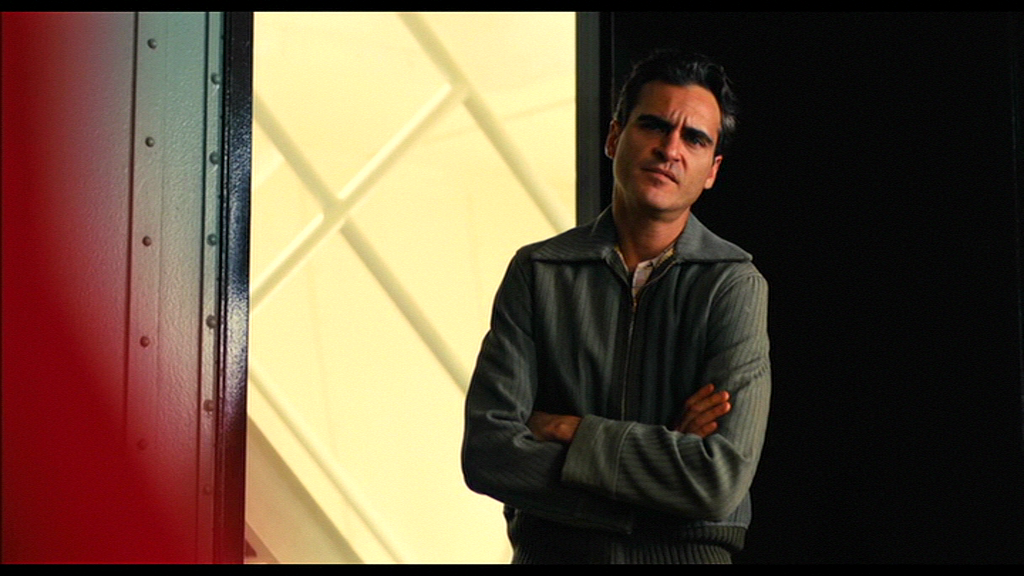

This first sequence depicts something of a balance between the two characters, Dodd as uncertain of Quell as Quell is of Dodd. Quell’s body language – the crossed arms, his indifferent smirk – understandably show little of the connection that will form and ultimately fracture between these two men. In this moment, the separate shots largely isolate each character from one another. However, Dodd’s dark red jacket clearly impinges into the periphery of the frame in Shot A, a subtle visual approximation of Dodd’s first exploitation of power and his manipulation of Quell – recruiting him into his company and his cause – that this scene represents.
Fast forward some thirty minutes of the film and the level of power Dodd now holds over Quell has now been amplified enormously. Now positioned as the Master’s lapdog, Quell has become part of The Cause and its surrounding family, even if certain members question his commitment to its shared goals and ideals. Eager to prove himself, Quell makes a visit to an outspoken sceptic of The Cause who provoked Dodd to outburst in an earlier sequence. After beating up the movement’s critic (off-screen), Quell is called into the office of Dodd to explain those actions which he has carried out in the name of The Cause. Mirroring their initial meeting almost exactly, the pair discuss what Quell did.

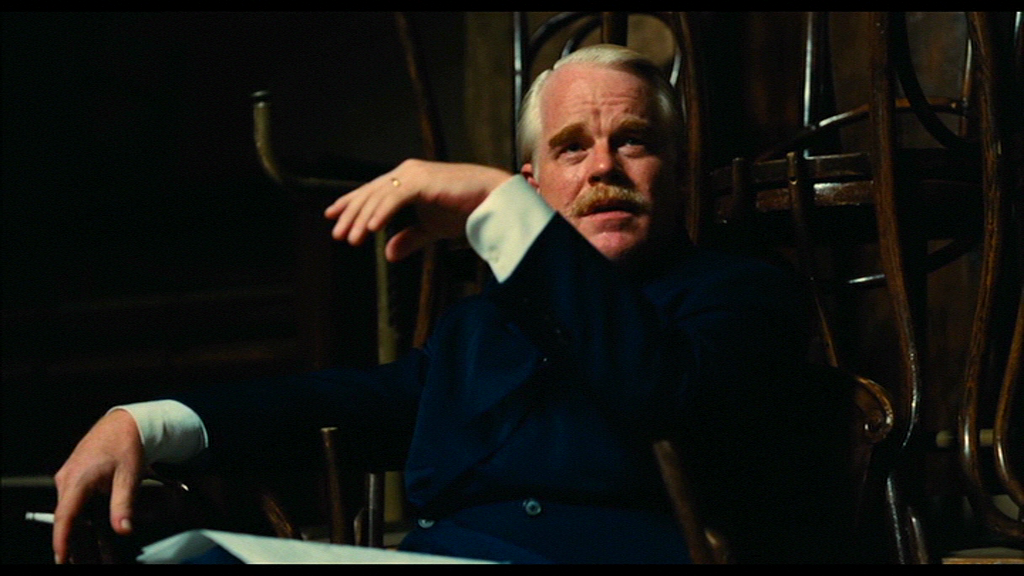
Hoffman’s character seen in Shot D, now dressed in an exquisite blue suit emblematic of his now established power status, sits much like he did in that first scene: his eye-line matching almost exactly what has come before. In contrast, the framing of Phoenix’s character is very different. Leaning against the door – which in itself appears to dwarf the actor in comparison to the size of the door’s frame – Quell stands casually with his arms to his side, his shirt, an almost effeminate purple.
Importantly, the figure of Dodd, even if out of focus, is the most prominent character within the frame: the peripheral presence of the character in Shot A of the first scene, now the focal point of the frame in Shot C. Like a father disciplining an unruly son, Quell stands shrinking in stature and significance under the power and gaze of his (at this point) infallible master.
In these instances, the development of their relationship, but more importantly the clear influence of power one character holds over the other, is captured by Anderson through such moments of precise visual structuring, mirroring and contrasting.


 Notes from the Multiplex